
Trace Wilcox Former Owners Backward
A deed-chain table keeps things tidy. One row per transfer, newest deed first. Record date, parties, book, and page. Then treat each deed's grantor as the grantee you hunt for in the next search back. The fields here are placeholders for results you pull yourself, not facts about one specific tract.
| Transfer date | Grantor to grantee | Deed type | Book/page |
|---|---|---|---|
| Newest recording | Prior holder to current grantee | Read the indexed instrument | Copy exact reference |
| Previous recording | Earlier holder to prior holder | Check deed category | Keep the linked volume and page |
| Older recording | Repeat with the same tract | Note estate, tax, or court transfer | Move to original books if needed |
Order the chain by recording date, and save the execution date when a deed shows one. Acreage matters. So do land lot, district, and plat references. Adjoining owners and lot-and-block calls count as well. A matching name on the wrong tract proves nothing, and the chain you build is research, not a title opinion.
Reconstruct Wilcox Ownership History
The GSCCCA real-estate name search is built for exactly this backward walk. Select Wilcox and set Party Type to Grantee. Enter the current owner as “last name, first name.” Narrow by date or instrument when results get noisy, open the newest plausible deed, and copy its grantor into the next search.
- Find the current grantee's acquisition deed and verify the Wilcox legal description.
- Record the grantor, instrument type, execution date, recording date, and book/page.
- Search that grantor as a grantee to find how the prior owner acquired the same land.
- Repeat until the central index no longer supplies a reliable link, then consult the clerk's original index and older books.
- Grantor
- The party conveying the stated interest.
- Grantee
- The party receiving that interest.
- Chain of title
- The ordered sequence of instruments affecting the same land.
- Reverse index
- An index organized by grantee, useful for finding how a holder acquired property.
- Warranty and quitclaim
- Different deed forms whose legal effect cannot be judged from the label alone.
Use Wilcox Grantor-Grantee Controls
GSCCCA filters run deep: Party Type, Instrument Type, County, neighboring counties, name, date range, results per page, and table display. Search grantor and grantee roles separately. A broken sequence usually has a legal cause. Estate documents, Deed From Estate, quit claim, warranty, sheriff's, and tax sale deeds, court orders, and foreclosure deeds all appear. They explain gaps in a simple buyer-seller list.
The GSCCCA name form displays the county, role, and instrument filters. Those filters drive the Wilcox former-owner trail.
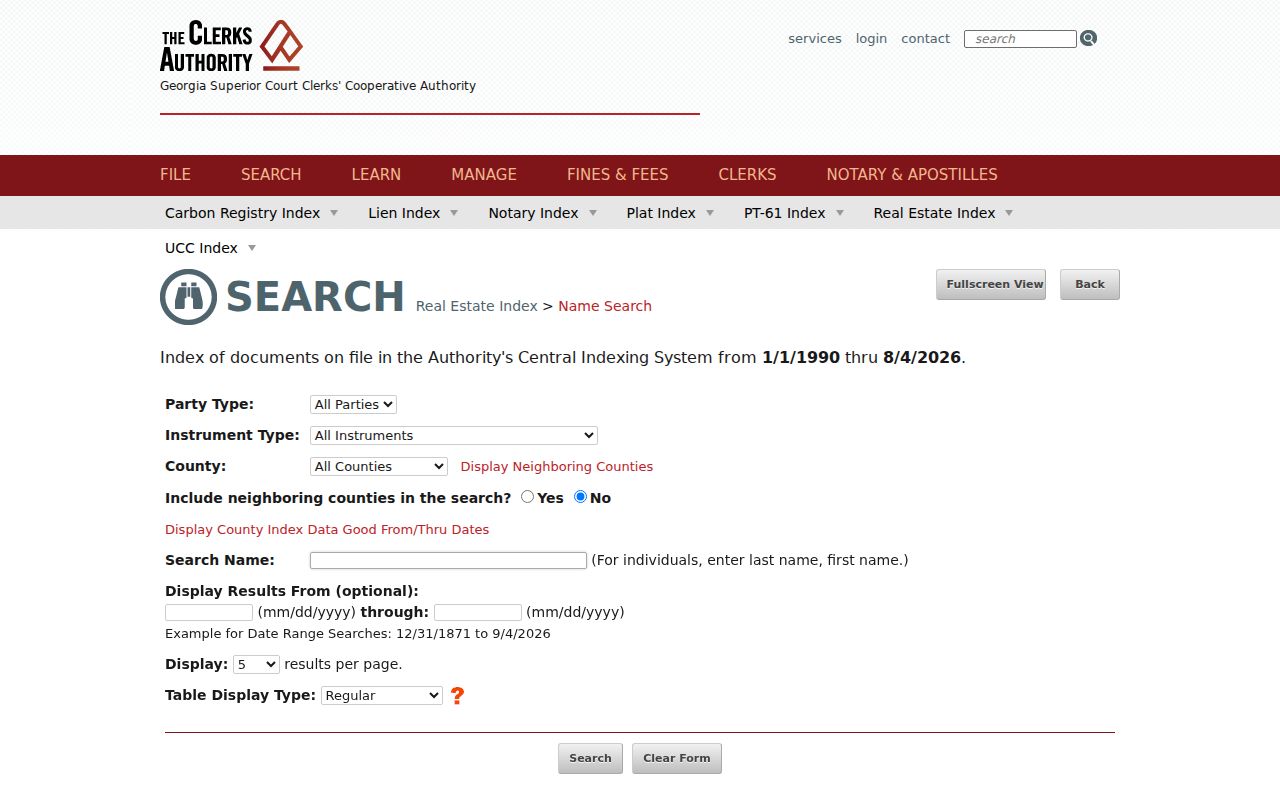
The form's county, role, instrument, and date choices support deliberate backward work. They help you avoid a broad surname scan. Historical GSCCCA entries may carry spelling or indexing errors. Some indexes were recreated from images, so mistakes can linger. Try initials. Try alternate spellings, co-grantees, and book/page when a link disappears. Keep neighboring counties off unless you have a reason to include them. If the central data conflicts with the Wilcox clerk's original index, the clerk's index controls.
Gauge Wilcox Ownership Record Depth
Users see a January 1, 1990 start date in the central GSCCCA interface. That date is a display value. It is not a verified Wilcox County online cutoff. Do not treat it as the county's first deed year. Ask the Clerk of Superior Court for Wilcox's good-from and good-through dates, the earliest local grantor and grantee indexes, and the location of deed books older than the web system.
Verify the cutoff. The central form's 1990 date is not a confirmed Wilcox limit. Earlier former owners may require local indexes, deed books, microfilm, or Archives holdings.
GSCCCA lists several account options. A single use costs $5 for four hours. Regular access runs $14.95 per month. Premium access is $29.95 per month, and printed images cost $0.50 per page. The Wilcox clerk sets access and certification procedures for the official record, so ask that office for current plain-copy and certified-copy costs.
Continue Wilcox Owners in Archives
The Georgia Archives county-record route opens doors to microfilm, finding aids, Virtual Vault, and FamilySearch. Georgia treats realty records as permanent. Pre-1900 county books may pass to Archives. Ask for the Wilcox deed-book run, grantor and grantee indexes, plat books, mortgage and release books, tax digests, and map books, and let Archives staff confirm shelf numbers and the earliest surviving volume.
No fire, destroyed decade, or WPA reindexing project marks Wilcox's record. The current courthouse dates to 1904. Its age proves nothing about the volumes inside. A missing digital image is an access gap. It does not mean the record was lost. Have the clerk or Archives point you to the next index.
Bridge Wilcox Estate Transfers
Probate material can rejoin a broken chain. Land often moves through death or an executor rather than a sale. Wilcox Probate Court files may hold petitions, inventories, notices to heirs, and administrator or executor details. Search the decedent's name, “estate of,” the representative, and later grantees, then return to the recorded deed or court order.
Georgia Archives holds a Wilcox marriage series for 1871–1895. Digitized marriage books span 1885 through 1916. FamilySearch's Georgia probate collection runs through 1990 and includes Wilcox. These sources reveal name changes, heirs, and family ties. They are clues around former owners, not substitutes for a conveyance.
Historic newspapers add legal notices for administrator, executor, sheriff, foreclosure, and tax sales. Record the publication date and exact party names. Test each notice against the clerk index. The news item explains context, but the recorded instrument remains the transfer evidence.
Marriage and probate records explain surname shifts too. Treat the relationship as a hypothesis. Until an estate order or deed ties it to the same legal description, genealogy stays separate from any ownership claim about the Wilcox County parcel.
Follow Wilcox Land, Not Addresses
Work from the land itself when tracing old ownership. Deeds written generations ago identify Wilcox County property by district, land lot, acreage, creeks, roads, adjoining owners, or plat references. They rarely use modern street addresses. Copy those descriptions exactly. Do not silently expand abbreviations, because small changes can break a search. A subdivision deed adds another layer. It cites lot, block, plat book, and page. Compare that reference against the recorded plat before trusting it. Parcel numbers also shift over time. Save any predecessor references shown on a live parcel card.
County geography complicates things further. Wilcox County was created in 1857 from parts of Dooly, Irwin, and Pulaski Counties. A deed or estate description dated before that creation is a red flag. It may sit in a parent county's records. Treat that as a lead, not proof of any particular book series. Ask the Wilcox clerk or Georgia Archives for the right crosswalk. Then move backward through the chain. Mailing names like Abbeville, Rochelle, or Pineview may not match the legal district either.
Keep Wilcox Prior-Owner Proof
Keep a source log for every link between prior owners. Record the name you searched, the person's role, county, date range, instrument type, execution and recording dates, book and page, legal description, and where the image sits. Log failed searches too. That habit pays off later, because it lets you explain why the chain jumped to an alternate spelling, a probate file, an original index, or a parent county.
For a certified deed copy or an unresolved gap, the Wilcox County Clerk of Superior Court can help at 103 N Broad Street, Abbeville, Georgia 31001, or by phone at 229-467-2442. The Wilcox County deed-record page explains the mechanics of pulling one instrument, while former-owner work stays focused on repeated backward links.
Lawful research. Use Wilcox County former-owner records for title, estate, purchase, and house-history work. Do not use them to track, harass, or harm a living person.